


 Published: 2025 - 06 - 19
 Source:
China News Service


Shenzhen, China, June 19 (China News Service Reporter: Suo Youwei) — The “Empowering Global Connectivity From Space — 2025 Shenzhen (Luohu) Aerospace Industry Conference & Cangyu Space Global Capability Launch” was held in Luohu District, Shenzhen, on June 19. The world’s first commercial high-orbit data relay satellite project was officially launched during the conference.
On the same day, representatives from 203 aerospace organizations, research institutions, leading enterprises, and investment institutions from China and overseas gathered to conduct in-depth discussions on commercial space technology innovation, industrial collaboration, and international cooperation.
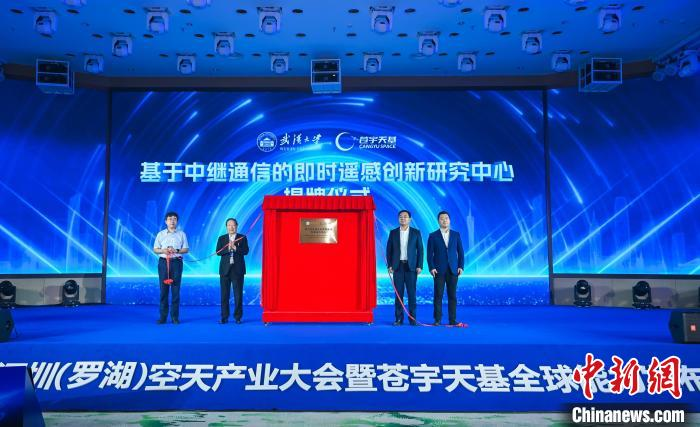
(Photo 1: Launch ceremony of the “Innovation Center for Real-Time Remote Sensing Based on Relay Communication.” Photo by Peng Cheng.)
According to an official from the Luohu District Investment Promotion Bureau, Luohu has selected the aerospace industry as one of the key drivers for industrial transformation and upgrading.
In terms of platform development, Luohu has established an aerospace industry innovation service platform by integrating resources from universities, research institutions, and enterprises to create an integrated collaborative innovation platform combining industry, academia, research, and application.
At the same time, Luohu has established low-altitude economy demonstration bases to provide companies with testing, verification, and application scenarios.
Through the development model of “leading enterprises + supporting enterprises,” Luohu has attracted more than 50 companies in areas including satellite communications, remote sensing applications, and spacecraft manufacturing, forming an innovation ecosystem covering upstream and downstream segments of the aerospace industrial chain.
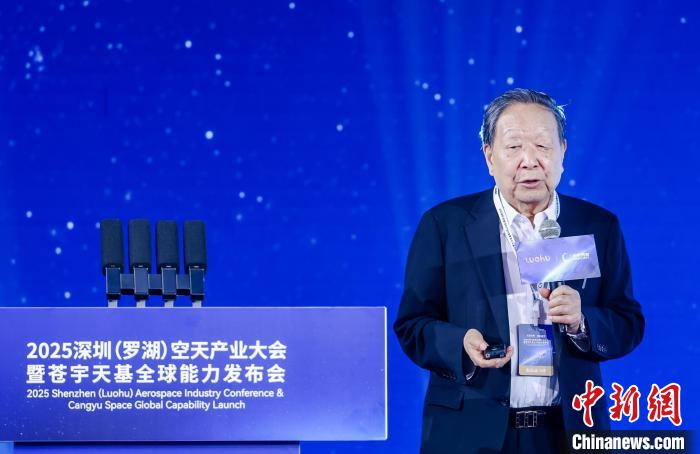
(Photo 2: Li Deren, recipient of China’s National Highest Science and Technology Award, delivers a keynote speech. Photo by Peng Cheng.)
During his keynote speech, Li Deren, Academician of the Chinese Academy of Sciences, Academician of the Chinese Academy of Engineering, and recipient of China’s National Highest Science and Technology Award, stated that the deep integration of spatiotemporal information with emerging technologies such as artificial intelligence, big data, and the Internet of Things has created a development landscape featuring mutual integration and mutual promotion.
He noted that spatiotemporal intelligence will generate new quality productive forces and drive the development of emerging industries, including the low-altitude economy, autonomous driving, smart elderly care, and the popularization of commercial remote sensing applications.
Li Deren emphasized that regions should accelerate the development of AI-driven integrated communication, navigation, and remote sensing (CNR) spatiotemporal intelligent services, promote the transformation of surveying and mapping science toward spatiotemporal intelligence, and support global sustainable development through technological innovation and industrial collaboration.
Christian Feichtinger, Executive Director of the International Astronautical Federation (IAF), stated that the peaceful utilization of outer space requires joint efforts from the international community.
He emphasized that by strengthening technological exchanges and mutual trust, countries can promote cooperation in communications, navigation, remote sensing, and other fields to address global challenges such as climate change and disaster response.
Global space development should shift from “national competition” to “collaborative innovation.” Countries around the world should share space-based resources, jointly explore the mysteries of the universe, and promote the standardization and sustainable development of the commercial space industry.
In his welcome remarks, Liu Wei, Chairman of Cangyu Space, stated that as the first commercial space company in China focusing on the development and operation of high- and medium-orbit space-based information systems, Cangyu Space has jointly established the “Innovation Center for Real-Time Remote Sensing Based on Relay Communication” with Wuhan University in Luohu.
The research center focuses on the integration of high-orbit relay satellite technologies and low-orbit remote sensing technologies. On the same day, Cangyu Space officially launched the world’s first commercial high-orbit data relay satellite project.
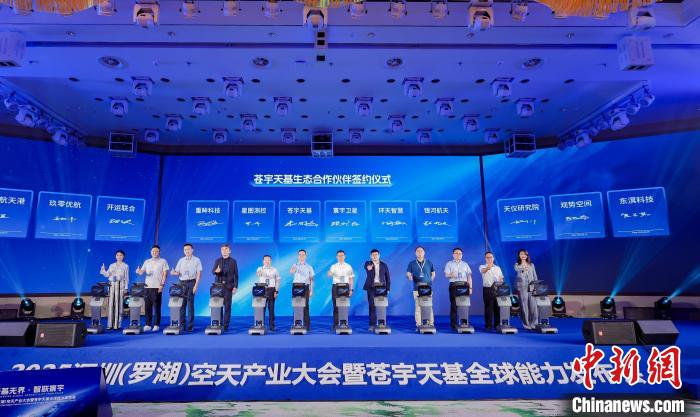
(Photo 3: Signing ceremony. Photo by Peng Cheng.)
At the launch event, Liu Hanchao, Co-founder and Executive Vice President of Cangyu Space, officially released Cangyu Space’s information service capabilities, user terminal portfolio, and data transmission specifications to global users.
According to the company’s development plan, Cangyu Space will launch the CY-G1 high-orbit satellite in 2026, achieving 60% low-orbit coverage and 40% surface coverage.
By 2027, the company plans to complete the deployment of a three-satellite high-orbit constellation, achieving 100% low-orbit coverage and surface coverage between 80° north and 80° south latitudes.
By 2030, Cangyu Space plans to complete the construction of the 13-satellite Cangyu Constellation, establishing all-time and all-weather coverage capabilities for both orbital and terrestrial applications.
At the launch event, Cangyu Space signed a satellite system and launch service turnkey contract for the CY-G1 GEO satellite system with China Great Wall Industry Corporation and China Aerospace Science and Technology Corporation (CASC) Commercial Satellite Co., Ltd.
Meanwhile, Cangyu Space reached cooperation agreements with 22 industry chain partners covering key sectors including satellite development, constellation operations, launch vehicles, ground equipment, and data applications.
Together, the partners will build an integrated aerospace industry ecosystem featuring coordinated development across the entire value chain.


